
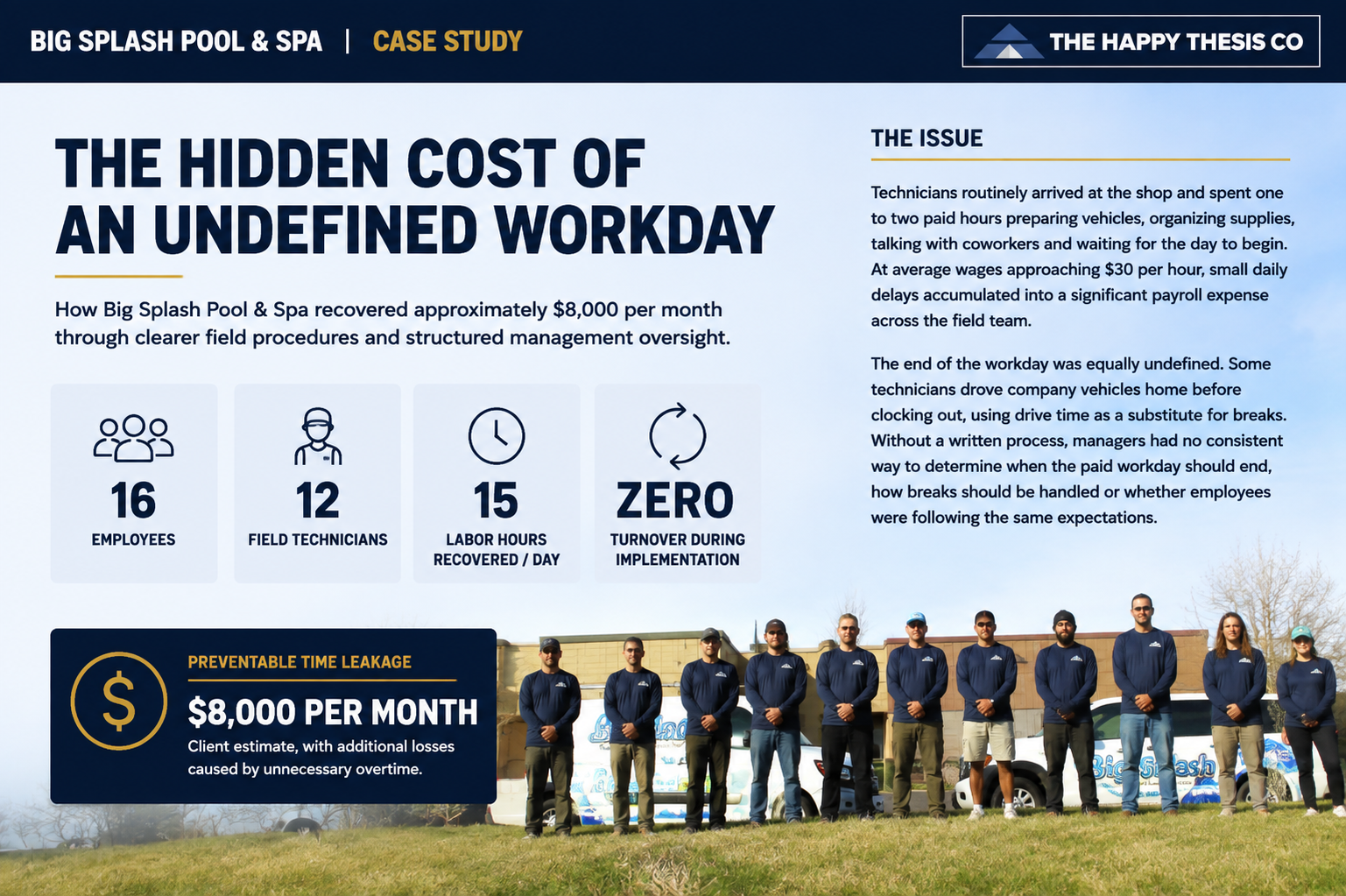
The hidden cost of an undefined workday.
How Big Splash Pool & Spa recovered approximately $8,000 per month through clearer field procedures and structured management oversight.
Download The Full PDF →A field team without a documented workday.
Big Splash Pool & Spa had grown into a substantial field-service operation with 12 technicians and four office and administrative employees. The technicians were experienced and hardworking, but the company had never clearly documented what the beginning, middle, and end of a productive workday should look like.
An hour here, an hour there, twelve times over.
Technicians routinely arrived at the shop and spent one to two paid hours preparing vehicles, organizing supplies, talking with coworkers, and waiting for the day to begin. At average wages approaching $30 per hour, small daily delays accumulated into a significant payroll expense across the field team.
The end of the workday was equally undefined. Some technicians drove company vehicles home before clocking out, reasoning that the drive replaced breaks they felt unable to take during a busy service day. Without a written process, managers had no consistent way to determine when the paid workday should end, how breaks should be handled, or whether employees were following the same expectations.
| What Was Happening | Business Effect |
|---|---|
| One to two paid hours spent preparing, organizing, or waiting at the shop. | Daily time leakage multiplied across 12 technicians. |
| Company vehicles were sometimes driven home before employees clocked out. | The paid workday had no consistent end point. |
| Breaks, meals, downtime, and route transitions were handled informally. | Managers could not distinguish legitimate delays from preventable inefficiency. |
Not a dishonesty problem. An operating-system problem.
No one had clearly told the technicians what management expected at each stage of the day. Employees were using personal judgment inside a system that provided few written standards and almost no consistent oversight. Managers could see payroll costs increasing, but they lacked the procedures, reports, and performance measurements necessary to identify the source and correct it fairly.
Undefined From The Start
When the paid workday began and ended, what route preparation required, and how long routine preparation should normally take.
Undefined In The Middle
How breaks, meals, and downtime should be handled, and what to do once assigned work was completed.
Undefined At The End
What documentation was required, and how managers would review time and performance.
This was not primarily a dishonesty problem. It was an operating-system problem.
A complete field operating system.
The Happy Thesis developed a structured field-operations system covering the technician’s entire workday, from arriving at the shop through completing the final customer record. Each procedure defined the required task, expected outcome, responsible employee, and a reasonable planning range for completion.
- Daily operations and route preparation
- Vehicle, tool, and inventory readiness
- Start-of-day and end-of-day responsibilities
- Standard pool and spa service
- New-customer visits
- Drain, fill, filter, and specialty services
- Repair escalation and equipment inspection
- Service documentation
- Field safety and emergency response
- Training, certification, and performance measurement
Not a stopwatch. Not zero-tolerance.
The new system did not pretend employees could work continuously without interruption. It expressly accounted for meals, rest breaks, coffee, snacks, travel, customer conversations, equipment problems, and the normal transitions that occur during a field-service day.
| The Standard | The Practical Effect |
|---|---|
| Define the normal planning range for routine work. | Employees understand the pace and outcome expected. |
| Allow documented exceptions for customer, equipment, or routing issues. | Managers can separate legitimate variance from recurring waste. |
| Review trends rather than policing isolated minutes. | Accountability becomes fairer, more useful, and less reactive. |
The objective was not to eliminate every quiet minute. It was to remove ambiguity.
From reactive supervision to structured oversight.
- Defined technician performance indicators
- Percentage-based KPI scorecards
- Route and documentation review procedures
- Timekeeping and overtime oversight
- Training and certification standards
- Coaching and remediation processes
Fifteen labor hours recovered, every working day.
At an average wage of approximately $30 per hour, the improvement returned roughly $450 in direct labor cost per day. The company also experienced a meaningful reduction in overtime, which had been placing additional pressure on payroll and service margins.
| Before | After |
|---|---|
| Workday start and finish depended on informal habits. | Start-of-day, route, and closeout responsibilities were documented. |
| Managers redirected work reactively and lacked reliable evidence. | KPI, route, timekeeping, and documentation reviews created visibility. |
| Employees guessed what productive work looked like. | Employees had clear expectations and a fair process for exceptions. |
| Time leakage and overtime were accepted as normal operating cost. | Approximately $8,000 per month was recovered through preventable loss reduction. |
Time leakage is rarely solved by telling employees to work harder.
It’s solved by clearly defining what work must be completed, what a completed task should look like, how long routine work should reasonably take, how breaks and downtime are handled, what happens when the schedule changes, how performance is measured, and who is responsible for reviewing the results.
Clear procedures protect company capital, create fairer employee expectations, and allow a growing business to operate without depending on constant owner supervision. The result isn’t simply lower payroll waste; it’s a more stable company with better customer service, stronger training, and management decisions grounded in evidence.
Financial estimates in this case study are based on client-reported staffing, average wages, and recovered time. Actual results vary by company, labor mix, implementation quality, and operating conditions.
 6 pages
Get the complete breakdown, start to finish.
The full PDF walks through the diagnosis, the field operating system we built, and the exact results, including the before-and-after data and the monthly savings math.
- The root cause behind the $8,000/month in preventable time leakage
- How the new field operating system was structured
- Full before-and-after results, including zero turnover during rollout
Want results like this for your business?
Tell us a bit about your field or team operations, and we’ll follow up to talk through what’s possible.